In the 1930s, the Town of Eagle was included in the crisis gripping “America’s Dairyland.” As the Great Depression deepened, local farmers like August and Grace Kutschenreuter navigated a landscape of plummeting prices, militant strikes, and a desperate search for federal financial lifelines.
The Economic Collapse
Between 1929 and 1932, Wisconsin farmers saw their income nearly halved. Milk prices—the lifeblood of Waukesha County—crashed from $2.01 to just $0.89 per hundredweight. With over 70% of the county’s farmland dedicated to dairy, this drop “guaranteed” foreclosures as local banks collapsed and credit vanished.
Militant Resistance & Milk Strikes
By 1933, despair turned to defiance. Waukesha County became a “center stage” for the Wisconsin Milk Strikes. Strikers raided plants and dumped milk to force prices up. In one of the era’s most famous local clashes at Durham Hill in Waukesha County, the National Guard used fixed bayonets and tear gas to break a farmer blockade. Farmers used “penny auctions” to stop foreclosures, where neighbors bid mere pennies on seized property to return it to the original owner, successfully intimidating bank agents.
The Federal Lifeline: FLB of St. Paul
The Emergency Farm Mortgage Act of 1933 introduced the Federal Land Bank (FLB) of St. Paul as a critical financial anchor. For Eagle farmers, this provided a way out of private debt: The FLB allowed farmers to swap high-interest private mortgages for federal loans with terms as long as 40 years and rates as low as 3.5%, and farmers only needed to pay interest for up to 10 years. They could borrow up to 50% of their land value and 20% of the value of permanent “improvements” like the large dairy barns and silos. While dairy was king, this credit also stabilized Eagle’s operations in oats, corn, barley, and livestock (pigs and sheep).
A Local Success Story: The Kutschenreuters
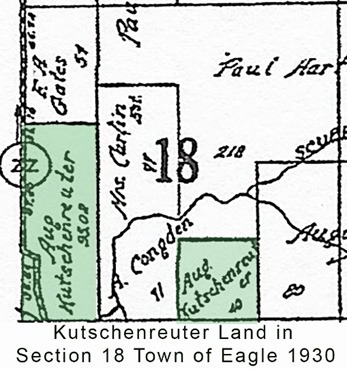 The story of August and Grace Kutschenreuter illustrates the era’s struggle and eventual recovery. In November 1933, at the height of the crisis, they mortgaged the 135-acre farm in Eagle which their son ran, plus additional land in Jefferson County, to the FLB of St. Paul for $6,800. By utilizing the long-term stability provided by the federal system, the Kutschenreuters weathered the Depression, finally satisfying their mortgage eleven years later in March 1944.
Mike Rice
~~~
Do you know when Arthur Juedes bought his farm and who did he buy it from? I thought it was in the 1920’s. When he stopped farming he put in the road from Grove Street to the park and he built about 10 of the homes in the 1950’s
Mary,
Thanks for contacting us about the Juedes farm. Arthur Juedes purchased the farm between 1938 and 1939 from the Wingerter family. We have a great article about it on our website. Click here to read it https://eaglehistoricalsociety.org/collections-archives/special-collections/eagle-area-farm-photography-project-2014/326-grove-st/